Building Confidence in Children: A Play Therapy Approach

“Do not do for the child what the child can do for themselves.”
This quote by Virginia Axline, one of the pioneers of play therapy, continues to be one of the principles in our practice of child-centred play therapy today.

Eight years ago, I began my journey as a play therapist. I transitioned from working in an agency to creating my own playroom at home—a cozy, intentional space designed for children to explore and express themselves freely. This approach felt deeply aligned with my beliefs about children’s mental health, growth, and resilience.

From the start, child-centred play therapy aligned with my values as a therapist. I felt naturally attuned to the child—following their lead, listening closely to their voice, and trusting that they already held the wisdom they needed to heal.

But I’ll admit—one part of this work challenged me. When a child struggled with something—trying to fix a toy, dress a doll, or build something that kept falling apart—my instinct was to jump in and help. It took a lot of self-awareness to pause and remind myself that my role wasn’t to rescue or fix, but to hold space and allow the child to try.

And when they finally figured it out—their face lighting up with pride and joy—it was always worth the wait. That moment of triumph belonged entirely to them. It built confidence, perseverance, and the deep internal motivation that only comes from experiencing success through effort.

I began to apply this same principle at home with my own children. I made a conscious effort to step back when I knew they were capable, even if it meant things took longer or didn’t turn out “perfectly.” It’s not always easy—watching your child struggle can tug at every instinct to help—but it’s often exactly what they need.

One memory that stands out is when my daughter started doing her hair for dance. She has ADHD and dyslexia, which for her means she’s very particular and often perfectionistic. No matter how gently I brushed, it was never quite “right.” One day, when she was about seven, I mentioned that it usually hurts less when you brush and do your own hair because you’re in control. That sparked something for her. She started by brushing her hair, then moved on to making ponytails, and eventually, she could do the whole hairstyle on her own. Now, she does her own hair every time—and she loves the independence (and I’ll admit, I’m pretty happy about it too!).

In both the playroom and at home, I’m always mindful of developmental readiness. A three-year-old may not be able to get a doll’s arm through a sleeve, so instead of doing it for them, I might ask, “Would you like some help?” and then support just enough to help them succeed. It’s the same concept teachers use—scaffolding—helping a child build one skill at a time so they can experience success and keep growing from there.

When Axline said not to do for the child what they can do for themselves, she was speaking about more than just independence. She was speaking about attachment and confidence. As caregivers, we are our children’s secure base—the place they return to for safety, comfort, and encouragement. When we step back just enough, we show them that we trust their abilities. We communicate, “I believe in you.”

When we step in too quickly, we unintentionally take away their opportunity to feel capable, proud, and resilient. However, growth doesn’t happen by tossing children into the deep end, but by gently teaching them how to float, kick, and swim—one step at a time.

And that’s really the heart of Axline’s message: our children don’t just need us to help; they need us to believe they can. When we trust them to try, we give them the space to discover their own strength.

Understanding Your Spirited Child: A Turning Point

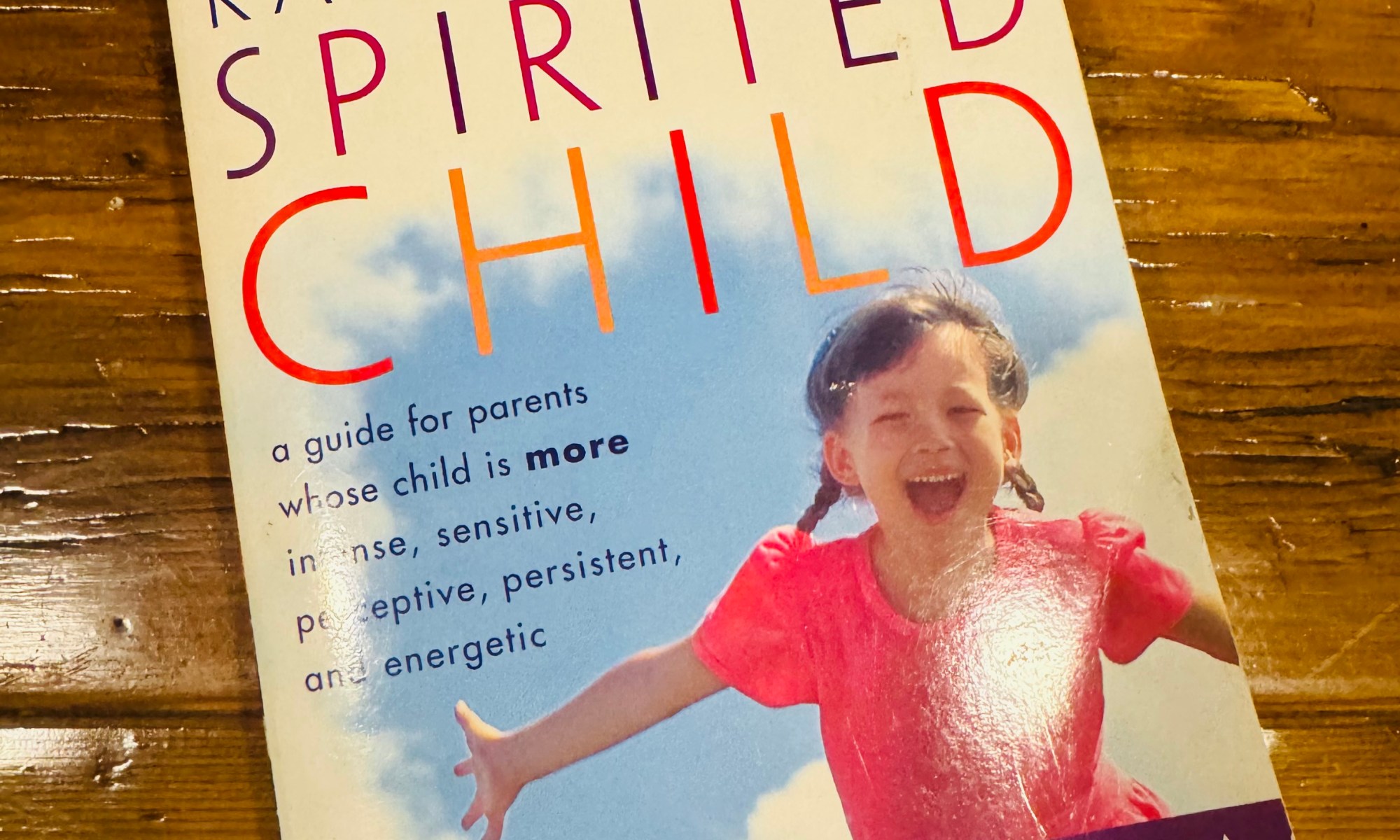
Yesterday, I found myself sitting across from my long-time play therapy supervisor—one of the most respected play therapists in Canada. At the beginning of our meeting that focuses on supervision, she offered me a few books she was no longer using. The first one she passed me was Raising Your Spirited Child. I looked at her and said, “This is a full circle moment.” Let me explain why.

When Wesley was an infant and toddler, I knew that parenting him would be different. I often felt judged by others, like no one truly understood what I was going through. I was constantly exhausted and on high alert, trying to meet the needs of my highly sensitive, deeply feeling child.

While most people around me did not get what I was feeling or experiencing, my mother-in-law was more understanding. For her, Wesley’s energy seemed normal. Her three boys were very similar. And while that was somewhat comforting, it also made me feel worse for struggling.

To give you a picture—Wesley didn’t walk, he ran. He didn’t sit still; he was in constant motion. He craved human connection, and as a young child, that person was always me. Sleep was a battle—he took forever to fall asleep and would wake up incredibly early.

If I had been an extroverted, sensory-seeking parent who thrived on social interaction and stimulation, this kind of intensity might have felt like a perfect match. But I wasn’t. I am the kind of person that often longs for peace and quiet. I get overwhelmed by noise and crowds. I love people, but I also deeply need my alone time. Back then, undiagnosed and untreated for ADHD, I was tired—drained.

And I was also doing my PhD.

The days when I was with Wesley for long stretches were particularly difficult—not because I didn’t love being with him, but because it was just the two of us, and he thrived in highly social environments. Yet there were very few social spaces that could accommodate his energy level at that age. The mismatch between what he needed and what I could offer felt heavy, and isolating.

Even through the exhaustion, I knew my son was a gift. His intensity, his passion, his emotions—these were qualities that would one day serve him. But in those early years, they were hard on me.

As someone raised in the pre-internet era, books were always where I turned to understand the world. I devoured parenting books, but nothing seemed to fit. Until one day, I found Raising Your Spirited Child. I remember reading it and weeping. For the first time, someone saw me. Someone saw him. Not in a negative light, but through a lens that highlighted his strengths, not just the challenges.

That book was a turning point. It validated what I had always known in my gut: my son didn’t need fixing—he needed understanding. And so, did I. That moment sparked a fire in me to learn more about the diversity of children’s brains, nervous systems, temperaments, and development. It was the beginning of a new path.

So, when my supervisor—now guiding me on my journey to becoming a play therapy supervisor—handed me that very same book yesterday, I paused. It was one of those quiet, powerful nudges from the universe.

A reminder: You’re on the right path. This work is for you.

From Grief to Growth: Starting a Therapy Practice in Honour of My Dad

I’ve wanted to be a therapist for as long as I can remember.

At 16 years old, after a fight with my high school boyfriend, I scribbled a list of life goals into my diary. Right at the top were two things: become a therapist and own my own practice. This was long before I had children of my own, before I understood how life would twist and turn, and before I knew how closely my path would align with the person who inspired it all—my dad.

There were detours, of course. I pursued a doctorate in anthropology—the study of human behaviour (so not too far off track). But eventually, I returned to those original goals. Today, I am a therapist, and I do run my own practice. Looking back, I had a clear sense of direction early on—but what drew me to therapy? And why work with children?

The answer is my dad.

My dad lived an extraordinary life considering where he came from. He grew up in a home shaped by adversity: abuse, addiction, violence, incarceration, and neglect. If you’re familiar with the Adverse Childhood Experiences (ACEs) study, you’ll know that scoring high on it correlates with many poor outcomes. My dad had a perfect ACE score. That’s not the kind of test where you want full marks.

By all accounts, my dad should not have made it. But he did. He not only survived—he thrived. He worked at IBM, married my mom (his high school sweetheart), had two children, and coached many others who needed a father figure. He became the most compassionate, empathetic, and quietly courageous man I’ve ever known.

He taught me to look for people’s stories before judging them. He believed in the good in others and never gave up on anyone. He loved unconditionally. My dad once dreamed of becoming a social worker, but when he shared that with others, they laughed at him. This made me both angry and left me with deep sadness for him. Instead, he poured his heart into volunteering, friendships, and showing up for his community. He modeled what it meant to love deeply, support a strong woman (my mom), and live with unwavering loyalty and kindness.

He was also the first person who made me see the power of early intervention. When he shared stories from his childhood—especially when drinking—I saw a boy in pain, a child who had no one to help him navigate what he was living through. And I wanted to help all the other children like him.

Research tells us that someone with my dad’s background shouldn’t have lived the life he did. But he beat the odds. How? I suspect part of it was his intelligence—he was smart, resourceful, a problem-solver. Possibly neurodivergent (We’ll never know). But more than that, he had people who loved him: a grandmother he loved, loyal friends, and a partner who loved, challenged and accepted him. And he had hockey—his outlet, his escape, his lifeline. He always said hockey and my mom saved him.

Even in his final days, my dad was still helping others. He lived each day like it might be his last, and on June 10, 2020—exactly five years ago today—he ran out of days. My world cracked open. I had three young kids and an ocean of grief I didn’t know how to navigate. He had been the healthy one in comparison to others—active, social, full of life. He didn’t deserve to go, not like that. But 15 months after his pancreatic cancer diagnosis, he was gone.

And something shifted in me.

It may be the ADHD part of my brain, but after his death, I felt no fear. The anxieties that used to hold me back evaporated. I kept thinking: What if I only have 25 years left? What do I want to do with that time?

In that clarity, I created Bloom: Child & Family Therapy.

There was no hesitation. No doubt. I just knew I had to do it. Bloom was created for children like my dad—for the kids with silent struggles, hidden pain, and immense potential. It was created to honour him.

Because of my dad, I believe in the power of healing. I believe every person—no matter their past or trauma—can move forward, grow, and thrive. He taught me to be still, to listen deeply, and to see the strength in every human being. And I carry that with me into every session, every conversation, every moment I spend with a child or family.

Five years later, I still miss him every day. But I also feel him—his lessons, his love, his legacy—woven into the work I do. Bloom isn’t just a practice. It’s a tribute. To a little boy who didn’t get the help he needed. To the man he became anyway. And to the lives we can change when we believe healing is always possible.

Parenting with Connection: A Transformative Approach

“A healthy woman is much like a wolf: robust, chock-full, strong life force, life-giving, territorially aware, inventive, loyal, roving,” writes Clarissa Pinkola Estés in Women Who Run with the Wolves: Myths and Stories of the Wild Woman Archetype.

I come back to this quote often, especially when reflecting on the experience of parenting a spirited, highly sensitive, or neurodiverse child. From my own journey—and through the stories of many other women—I know that deep gut feeling that something is different about your child. It’s an intuitive knowing, often dismissed by others. Peers, family, and institutions frequently respond with judgment: labeling it “bad behaviour” or blaming “poor parenting.”

This stigma persists in what Gary Zukav calls our “five-senses world”—a surface-level way of seeing things. It pulls us away from love and connection, and toward fear. We are warned that if we “give in” to a child’s behaviour, we’ll somehow make it worse. We’re told we need to be more strict, create firmer boundaries, push harder. The narrative becomes one of laziness, manipulation, and lack of effort.

But beneath that fear-based messaging lies something else: our collective fear of getting it wrong. Of raising a child who might leave school, struggle to find a job, or never settle into a “successful” life. And often, when others push that fear onto us, it reveals their own discomfort—especially when they see someone parenting differently. Their fear of difference becomes a mirror.

So what does that fear do to us, as parents?

Let me tell you a story.

My eldest son plays hockey. In his elementary years, he struggled with emotional regulation—particularly anger, especially when faced with perceived injustice or rejection. These are common challenges for kids with ADHD. During games, he would sometimes take a bad penalty for saying or doing something impulsive. And if you’ve ever been involved in competitive youth sports, you know that kids who show their strong, often angry emotions and act upon them are quickly labeled: “hothead,” “unreliable,” “a problem.”

At first, my husband and I followed the typical script. After a tough game, we’d come down on him for losing control. Naturally, he would lash out at us in return. The evenings were filled with meltdowns and spiraling anxiety.

I was parenting the behaviour—but my gut told me there was something deeper going on.

So I changed my approach. Instead of confronting him after a game, I started simply by asking how he felt. That one shift made a difference. He would share frustrations: a coach yelling, a teammate making a rude comment, the sting of criticism. These conversations helped me understand what was happening beneath the surface—often feelings of inadequacy or injustice.

From there, I focused on validating his emotions. We talked about how he felt about his reactions and what he might want to try next time. I explained how his actions impacted others—not to shame, but to teach. He began to learn about himself, with me as a supportive guide rather than a disciplinarian. We were still addressing behaviour, but in a way he could actually receive.

The change didn’t happen overnight. But gradually, he became more reliable on the ice. He wasn’t as easily rattled by other players or negative feedback. He still got upset sometimes—don’t we all?—but now he would come to me. He could talk about his feelings and, together, we found solutions.

This approach raised eyebrows. Some parents didn’t agree with how we handled things. But here’s what I’ve learned: any mother who parents differently than the norm will face skepticism. And that’s okay. Our job isn’t to change other people’s minds. Our job is to parent our child, the one right in front of us, using the instincts we carry as their mother.

As my confidence grew, the opinions of others mattered less. My son kept coming to me. He kept opening up. He took responsibility for his mistakes and worked to repair them—at home, at school, and in life. That’s how I knew I was on the right path.

The practice I’ve built today—supporting families and children—was born, in part, out of the experiences of raising my children. It came from learning to trust myself, to lead with love and curiosity, and to put the relationship with my child above everything else. Parenting from this place isn’t always easy, but it’s transformative.

Because when we stop parenting out of fear and start parenting from connection, we create space for our children to thrive—and for ourselves to truly lead like the wolves we are: strong, intuitive, loyal, and wild.

Navigating Life Without a Script: A Journey of Self-Discovery

Looking back, I remember constantly feeling like everyone else had received some kind of manual for life—and I’d somehow missed it. It was as if teachers, parents, and coaches had whispered instructions to everyone but me. I’d blame it on my daydreaming, which I did constantly. I’d sit through lessons lost in thought, choreographing dances in my head, creating stories, planning projects. On the outside, I appeared to be listening. But inside, I was in another world—bored, disconnected, and silently struggling.

I didn’t talk about it. Somehow, I knew not to. I couldn’t quite explain it anyway.

Years later, in graduate school, I discovered the work of sociologist Erving Goffman, who wrote about the “performance of everyday life.” Finally—an explanation. Everyone, Goffman said, is performing: as children, friends, teammates, students. Life is a stage, and we’re all playing roles. But even as I absorbed this insight, something still didn’t sit right. If everyone was performing, how did they know their lines?

It wasn’t until my late 30s—after being diagnosed with ADHD-Combined type—that things really began to click. I dove headfirst into everything ADHD. That’s when I found others describing the exact feeling I’d had for decades: like there was a script everyone else had been handed, and we just… hadn’t.

I imagine it like this: a woman walks into an audition, and everyone expects her to recite lines from a script. Only—she was never given one.

That image explained so much. When I got to university, it seemed like everyone already knew about academic journal articles. I figured it was because I was the first in my family to attend university. But then I met others with similar backgrounds who did know. Was it socio-economic? Was it ADHD? I still can’t say for sure. But I know one thing: I didn’t have the script, so I faked it until I figured it out.

I have dozens of stories like this—moments where I masked confusion or mimicked others, just trying to fit in.

Through my work, research, and especially parenting neurodivergent children, I’ve come to understand that much of what I experienced wasn’t a personal failure—it was a disabling environment. The systems I moved through were designed for neurotypical brains and nervous systems. That’s not to say neurotypicals don’t perform or fake it, too. But the key difference? They’re performing from a script written with them in mind.

Take our school system. It expects children to sit still, absorb information passively, and produce it on demand—through worksheets, tests, and timed exams. For many neurodiverse learners, that’s a recipe for struggle. They often thrive with hands-on, multisensory learning—by moving, creating, experimenting, and processing on their own timeline. But instead of embracing these strengths, many schools label them as distracted, defiant, or disorganized.

It was in high school that I began to uncover an approach that worked for me. I chose projects that aligned with my interests to stay engaged. I avoided classes based heavily on memorization, knowing my working memory wouldn’t serve me well there. Without realizing it, I was accommodating my neurodiversity. I was leaning into my strengths—curiosity, creativity, and a deep love for learning.

And that’s the shift I want to emphasize.

When neurodivergent people understand how they think, feel, and learn best, they stop trying to cram themselves into someone else’s mold. They start building their own toolkit, their own pace, and yes—even their own script.

So if you’ve ever felt like you missed the instructions, like you’re always one step behind, like you’re pretending to “get it”—know that you’re not broken. You’re navigating a world that wasn’t built with you in mind.

But the beautiful part? You don’t have to keep faking it. You can start writing your own lines.