
Looking back, I remember constantly feeling like everyone else had received some kind of manual for life—and I’d somehow missed it. It was as if teachers, parents, and coaches had whispered instructions to everyone but me. I’d blame it on my daydreaming, which I did constantly. I’d sit through lessons lost in thought, choreographing dances in my head, creating stories, planning projects. On the outside, I appeared to be listening. But inside, I was in another world—bored, disconnected, and silently struggling.
I didn’t talk about it. Somehow, I knew not to. I couldn’t quite explain it anyway.
Years later, in graduate school, I discovered the work of sociologist Erving Goffman, who wrote about the “performance of everyday life.” Finally—an explanation. Everyone, Goffman said, is performing: as children, friends, teammates, students. Life is a stage, and we’re all playing roles. But even as I absorbed this insight, something still didn’t sit right. If everyone was performing, how did they know their lines?
It wasn’t until my late 30s—after being diagnosed with ADHD-Combined type—that things really began to click. I dove headfirst into everything ADHD. That’s when I found others describing the exact feeling I’d had for decades: like there was a script everyone else had been handed, and we just… hadn’t.
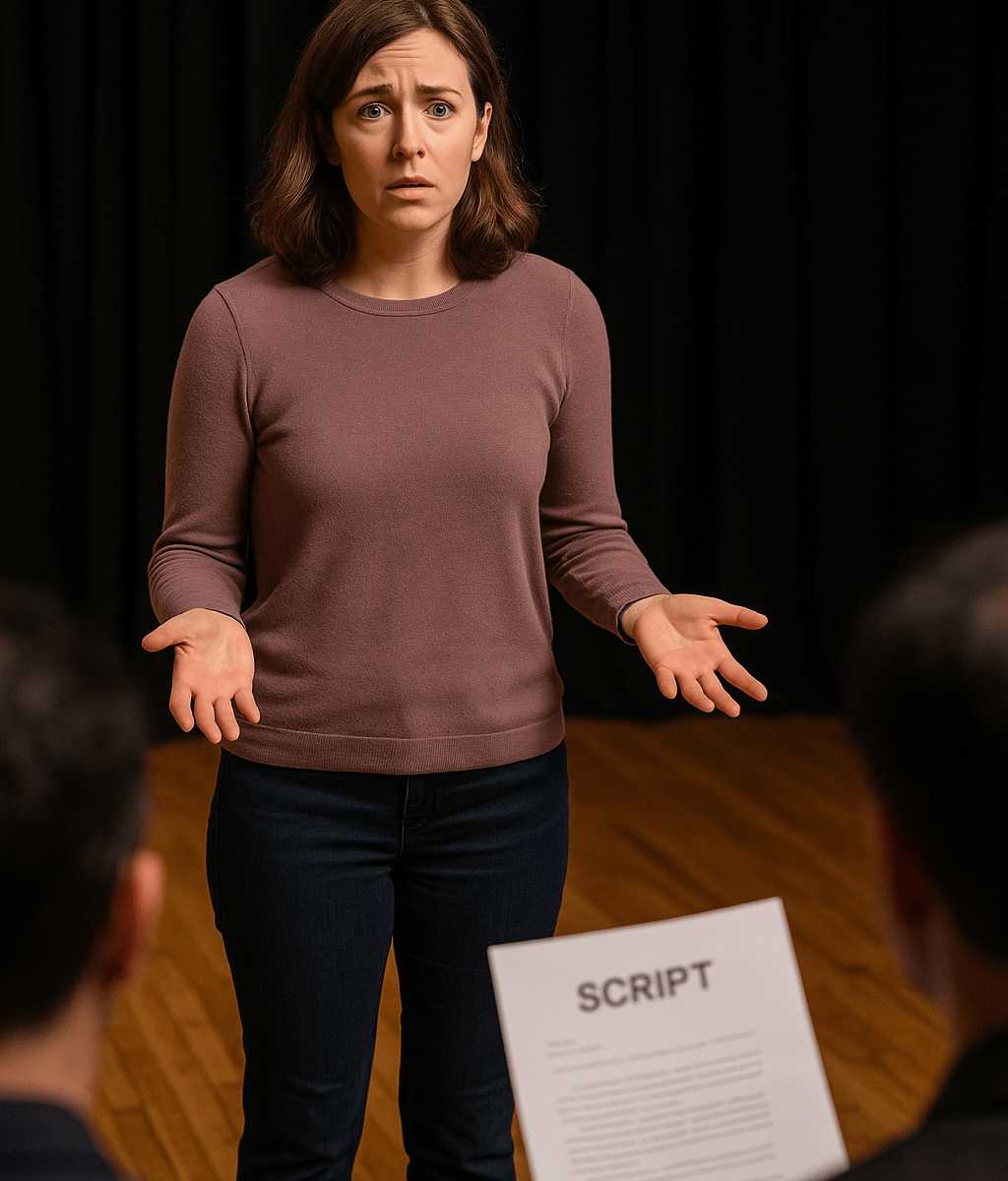
I imagine it like this: a woman walks into an audition, and everyone expects her to recite lines from a script. Only—she was never given one.
That image explained so much. When I got to university, it seemed like everyone already knew about academic journal articles. I figured it was because I was the first in my family to attend university. But then I met others with similar backgrounds who did know. Was it socio-economic? Was it ADHD? I still can’t say for sure. But I know one thing: I didn’t have the script, so I faked it until I figured it out.
I have dozens of stories like this—moments where I masked confusion or mimicked others, just trying to fit in.
Through my work, research, and especially parenting neurodivergent children, I’ve come to understand that much of what I experienced wasn’t a personal failure—it was a disabling environment. The systems I moved through were designed for neurotypical brains and nervous systems. That’s not to say neurotypicals don’t perform or fake it, too. But the key difference? They’re performing from a script written with them in mind.
Take our school system. It expects children to sit still, absorb information passively, and produce it on demand—through worksheets, tests, and timed exams. For many neurodiverse learners, that’s a recipe for struggle. They often thrive with hands-on, multisensory learning—by moving, creating, experimenting, and processing on their own timeline. But instead of embracing these strengths, many schools label them as distracted, defiant, or disorganized.
It was in high school that I began to uncover an approach that worked for me. I chose projects that aligned with my interests to stay engaged. I avoided classes based heavily on memorization, knowing my working memory wouldn’t serve me well there. Without realizing it, I was accommodating my neurodiversity. I was leaning into my strengths—curiosity, creativity, and a deep love for learning.
And that’s the shift I want to emphasize.
When neurodivergent people understand how they think, feel, and learn best, they stop trying to cram themselves into someone else’s mold. They start building their own toolkit, their own pace, and yes—even their own script.
So if you’ve ever felt like you missed the instructions, like you’re always one step behind, like you’re pretending to “get it”—know that you’re not broken. You’re navigating a world that wasn’t built with you in mind.
But the beautiful part? You don’t have to keep faking it. You can start writing your own lines.
 Melissa Fellin MSW, RSW, MA, PhD, CPT